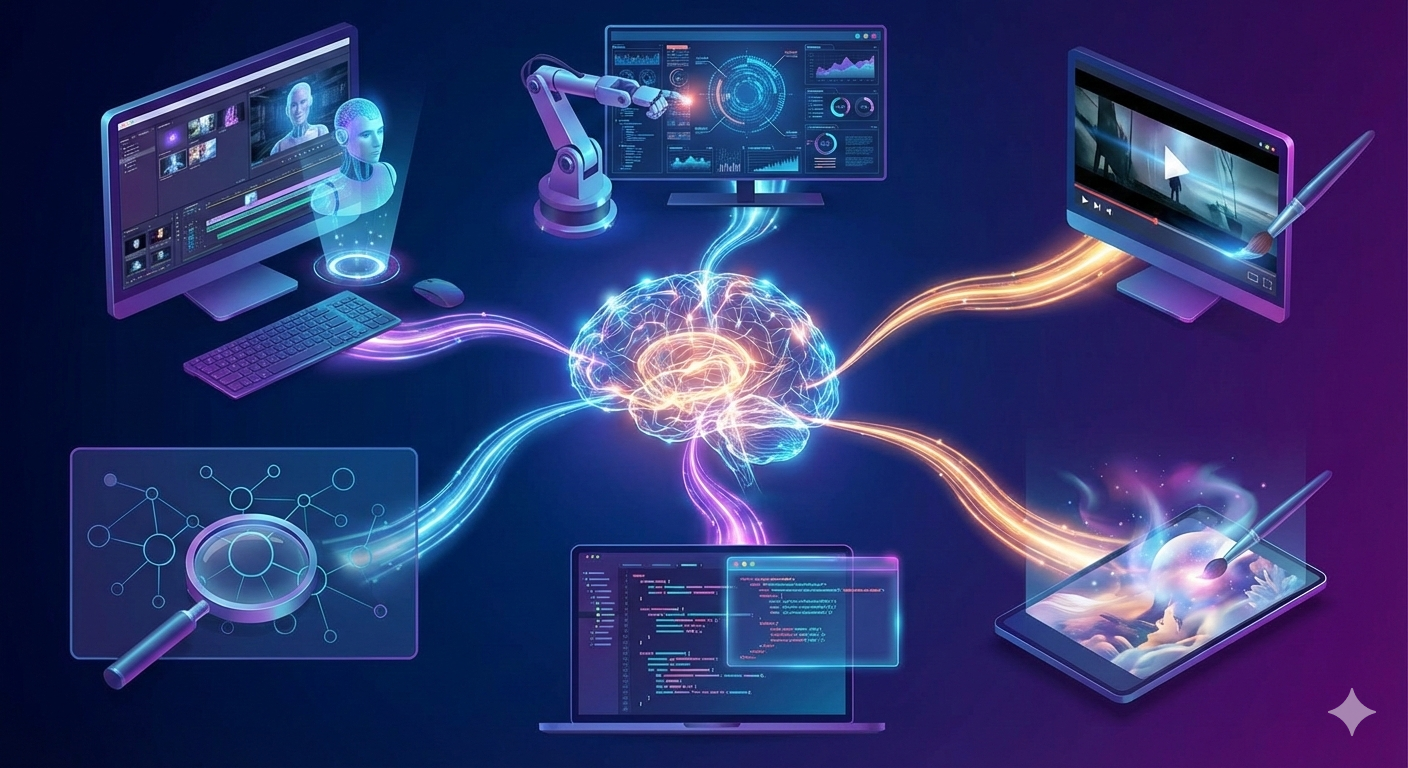
The digital landscape is shifting under our feet, driven by a surge of artificial intelligence that goes far beyond simple chatbots or basic image filters. We are entering an era of “agentic” and generative creativity where tools don’t just assist—they execute, imagine, and collaborate.For creators, developers, and entrepreneurs, staying ahead means adopting platforms that fundamentally change how value is created. These emerging solutions are dissolving the technical barriers between a raw idea and a finished product, whether that product is a cinematic video, a complex codebase, or a deep-dive research report.
The following guide explores six transformative platforms that are defining this new frontier. From hyper-realistic video synthesis to autonomous coding environments, these are the instruments of the modern digital artisan.
1. Invideo
In the competitive world of content creation, speed and consistency are often at odds with quality, but recent advancements in generative media are bridging that gap. Invideo has positioned itself as a comprehensive ecosystem for video production, allowing users to turn text prompts into publish-ready videos complete with stock footage, voiceovers, and subtitles. A standout feature in their latest update is the ai avatar generator, which sits in the middle of their toolkit as a game-changer for personalized branding. This capability allows users to create a digital twin that mimics their likeness and voice, enabling the production of “face-to-camera” content without ever needing to step in front of a lens. By uploading a small sample of footage, creators can generate hours of training videos, social media updates, or personalized sales pitches where the avatar speaks any text provided, maintaining perfect lip-sync and natural mannerisms.
Beyond desktop capabilities, the platform understands the need for on-the-go creation. The ai video creator app extends these powerful features to mobile devices, ensuring that inspiration never has to wait for a desk setup. Users can type a prompt into their phone, and the system creates a fully edited video in seconds. This mobile integration is particularly potent for social media managers and influencers who need to capitalize on trends instantly. The tool also introduces “User Generated Content” (UGC) modes, where AI-generated characters can deliver testimonials or product reviews that feel authentic and relatable. With support for over 50 languages and the ability to clone voices for seamless localization, Invideo provides a frictionless path from concept to global distribution, removing the heavy lifting of traditional video production.
2. Claude 3.5 Sonnet (Anthropic)
While many language models can write code or summarize text, Anthropic’s Claude 3.5 Sonnet has introduced a capability that redefines the relationship between humans and AI: “Computer Use.”This feature moves the model from being a passive text generator to an active agent capable of navigating a computer interface just like a human would. It can look at a screen, move a cursor, click buttons, and type into standard text fields.This “agentic” workflow opens doors for automating complex, multi-step tasks that previously required custom API integrations or manual human effort. For instance, a user could instruct Claude to “find the best flight options to London, put them in a spreadsheet, and email the summary to the team,” and the model can execute these steps by interacting with a browser and spreadsheet applications directly.
Beyond its agentic skills, this model is celebrated for its nuance and reasoning capabilities. It excels in coding tasks, often outperforming competitors in debugging and architectural planning. Its visual processing is equally robust, allowing it to interpret complex charts, graphs, and handwritten notes with high accuracy. For developers and data analysts, this tool acts less like a search engine and more like a senior engineer or research assistant—one that can not only suggest a solution but also open the necessary files and implement the changes itself. This shift from “chatting” to “doing” marks a critical evolution in how professionals leverage artificial intelligence for productivity.
3. Runway Gen-3 Alpha
Video generation has long been the “final boss” of generative AI, due to the immense complexity of maintaining temporal consistency—keeping objects and characters stable as they move through time. Runway Gen-3 Alpha represents a massive leap forward in this domain. It offers high-fidelity video synthesis that adheres to the laws of physics more closely than its predecessors. This tool allows creators to generate photorealistic video clips from text prompts, images, or existing videos, with a level of control that filmmakers demand. Features like “Motion Brush” allow users to “paint” specific areas of an image to tell the AI exactly what should move and in which direction, granting granular control over the final output.
What sets Gen-3 Alpha apart is its understanding of cinematic language. Users can prompt for specific camera movements—zooms, trucks, pans—and lighting setups, and the model executes them with professional-grade aesthetics. The tool is also pushing boundaries with its ability to generate realistic human characters that display a wide range of emotions and actions without the uncanny “morphing” artifacts common in earlier generations. For marketing teams, storyboard artists, and indie filmmakers, Runway provides a virtual studio where the only limit is imagination, enabling the visualization of complex scenes that would otherwise require expensive CGI or practical effects.
4. Perplexity AI
The traditional search engine model—typing keywords and sifting through blue links—is being dismantled by Perplexity. This “answer engine” combines the vast knowledge index of the web with the reasoning capabilities of advanced Large Language Models (LLMs). Instead of providing a list of websites, Perplexity reads through reputable sources in real-time and synthesizes a direct, comprehensive answer to the user’s query, complete with citations. This transparency allows users to verify facts instantly, a crucial feature in an era of information overload.
For digital innovators, the “Pro Search” feature is particularly valuable. It breaks down complex queries into sub-questions, conducting a multi-step research process to provide a deep-dive report rather than a surface-level summary. Recent updates have added “Spaces,” a collaborative feature that allows teams to organize research threads, upload internal documents, and create a shared knowledge base. By integrating internal data with external web search, Perplexity serves as a powerful research assistant that helps teams make data-driven decisions faster. It transforms the act of “Googling” into a structured, insight-gathering workflow.
5. GitHub Copilot Workspace
Coding assistants have become standard, but GitHub Copilot Workspace takes the concept from “autocomplete” to a “copilot-native” development environment. Instead of just suggesting the next line of code, Workspace helps developers manage the entire lifecycle of a task. When a developer opens a GitHub issue, Workspace can analyze the codebase, propose a plan to fix the bug or implement the feature, and then generate the necessary code across multiple files.This plan-centric approach allows developers to review and refine the strategy in natural language before a single line of code is written.
The environment is designed to be steerable. If the proposed plan isn’t quite right, the developer can edit the steps, and the AI will regenerate the implementation accordingly. This creates a feedback loop where human intent guides AI execution. It drastically reduces the cognitive load of “context switching”—the mental effort required to understand how a change in one file affects the rest of the project. By handling the boilerplate and dependency management, Workspace frees developers to focus on high-level architecture and problem-solving, effectively acting as a pair programmer that knows the entire repository inside out.
6. Midjourney (Latest Model)
While many tools chase photorealism, Midjourney remains the king of artistic style and aesthetic depth. Its latest iterations continue to push the boundaries of what is possible in generative art. The platform has evolved to offer unprecedented control over image composition, texture, and lighting. New features allow for “character reference,” enabling users to keep a consistent character across multiple generated images—a feature that was previously the biggest hurdle for visual storytellers and graphic novelists.
Furthermore, the introduction of advanced upscalers and “inpainting” (Vary Region) tools allows creators to fix small details or expand the canvas of an image without losing the original style. The platform is also expanding into 3D and video capabilities, hinting at a future where it serves as a holistic visual creation suite. For designers, concept artists, and marketers, Midjourney offers a boundless source of inspiration and high-resolution assets that can be used for everything from website backgrounds to mood boards and final advertising creatives.19 Its ability to understand abstract and conceptual prompts makes it unique among generators, often delivering results that feel creatively “human” and serendipitous.
Conclusion
The tools highlighted here are not merely upgrades to existing workflows; they represent a fundamental shift in the digital value chain. We are transitioning from manual execution to strategic orchestration. With platforms like invideo, the barrier to creating professional broadcast media is vanishing. Tools like Claude and GitHub Copilot Workspace are turning everyone into a potential developer or data scientist.
As these technologies mature, the defining skill for digital professionals will not be technical proficiency in a specific interface, but the ability to articulate a clear vision and guide these powerful agents toward it. The next wave of innovation belongs to those who can best collaborate with these synthetic partners, leveraging their speed and scale to bring ambitious ideas to life. Integrating these solutions today is not just about saving time—it is about securing a competitive advantage in a future where creativity and execution are instantaneous.